 Mini Detour
Still open when
you get there.
Mini Detour finds the pharmacy, the bakery, the parcel point that costs you the least time off the road you are already driving — and checks the hours for the moment you arrive, not the moment you ask.
- On-route, not just nearby
- Checked at arrival time
- EV or petrol
- No account, no sign-up
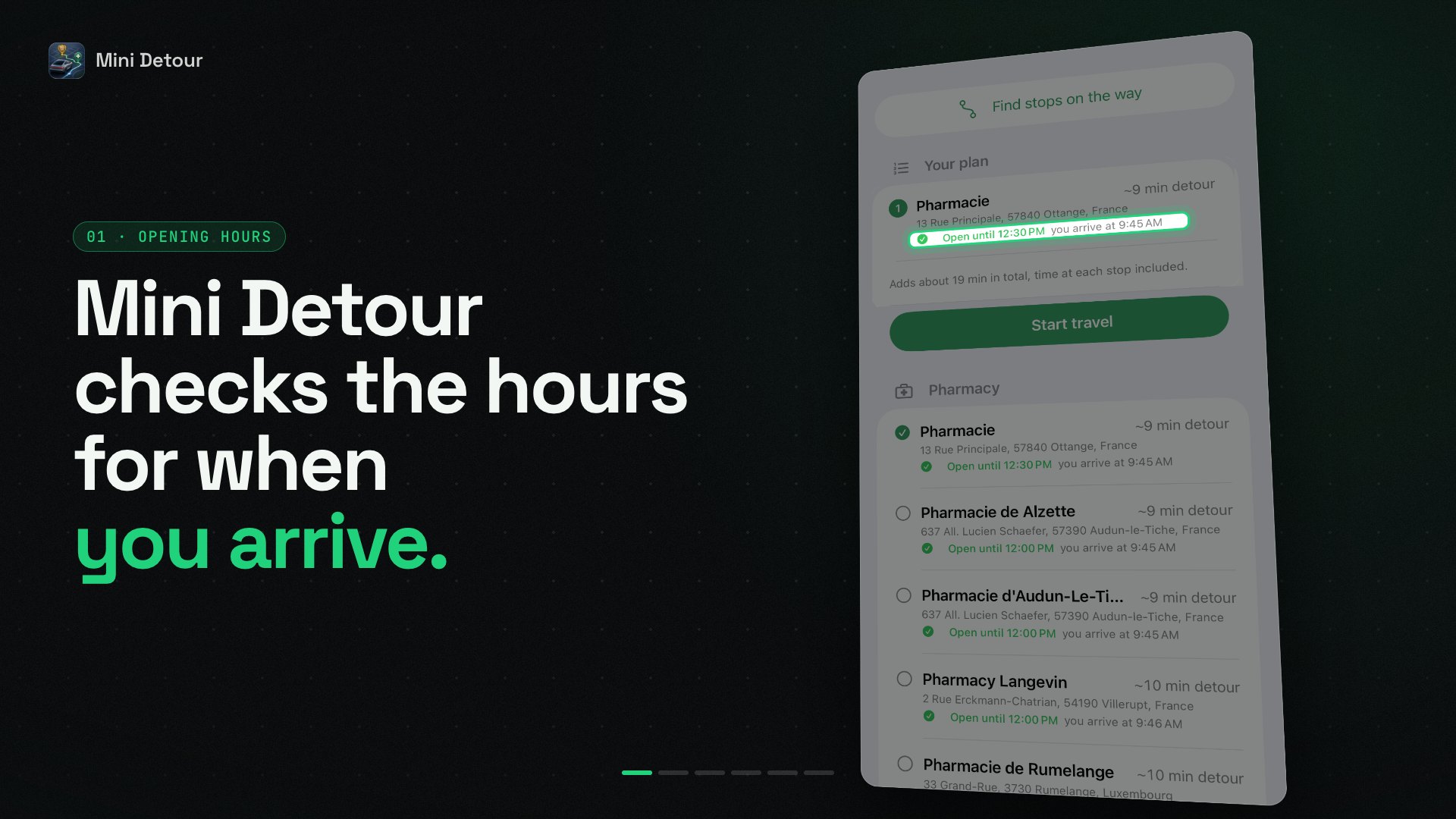
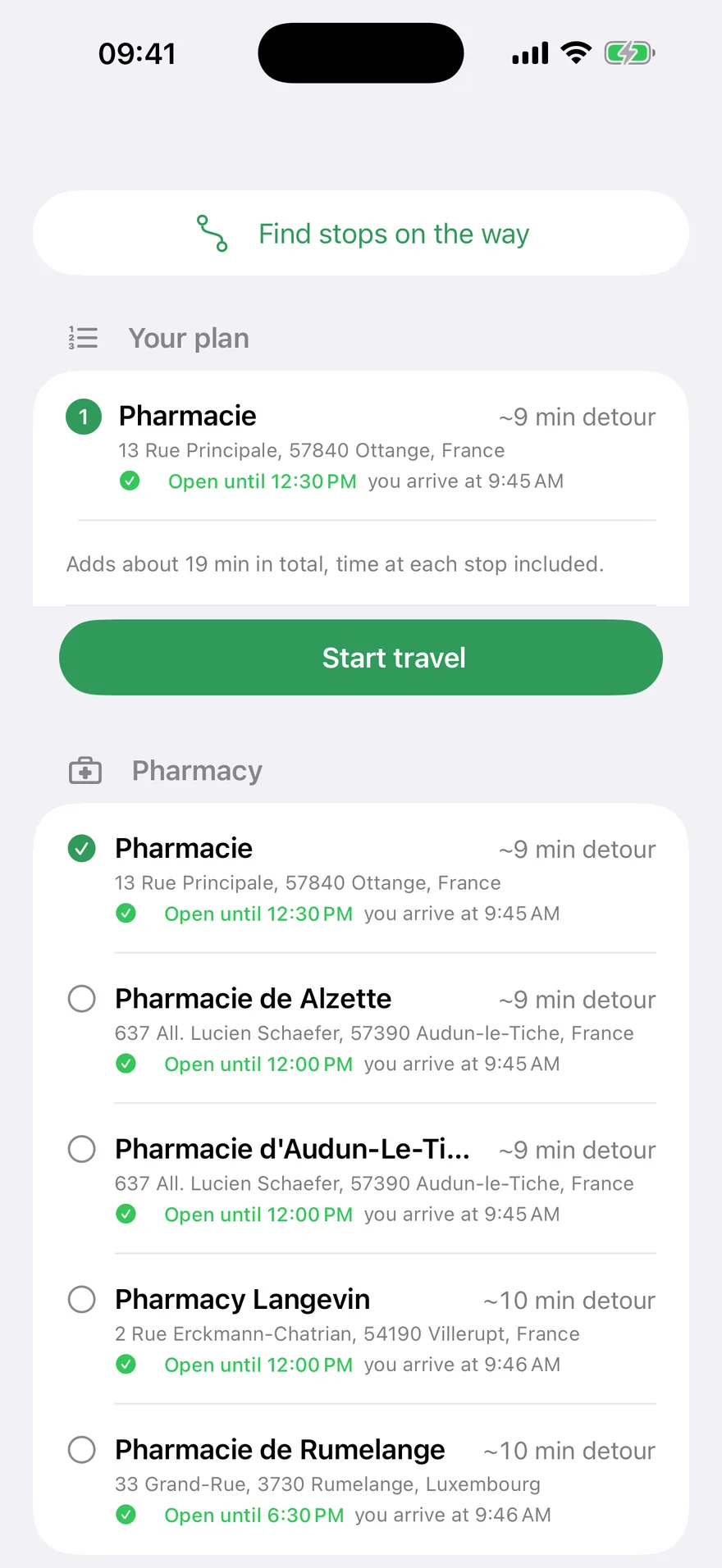
This is the screen you get.
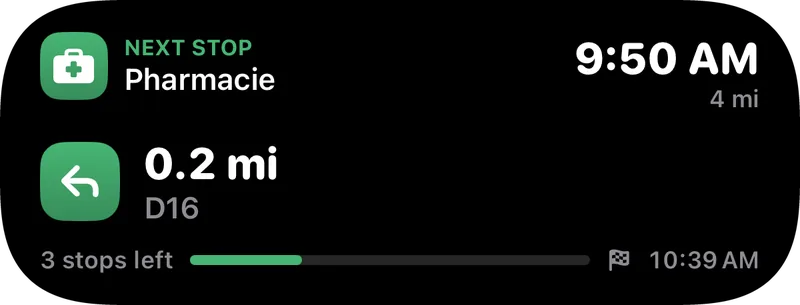
No mock-ups: the planner here is captured from Mini Detour itself. The errand you asked for, the stop with the smallest detour, and whether it is still open at the time you will actually get there — with the Live Activity already waiting on the Lock Screen.
“Open now” answers a question you never asked.
You are thirty minutes away. Every map on your phone says the pharmacy is open — and it is, right now. You arrive at 19:12. It closed at 19:00. The information was accurate and completely useless.
Four things have to be true before a stop is worth showing you.
Mini Detour is a small piece of operations research wearing a friendly interface. Every candidate goes through the same four tests, in this order.
It is on your way
Candidates are drawn from a corridor along your actual route line — not a circle on a map. Three kilometres away as the crow flies can be a fourteen-minute round trip when the next exit is behind you.
The detour is measured
Every candidate is priced as a real road-network detour: drive to it, drive back to the route, compare against driving straight through. That is a travel-time matrix, not a straight-line distance.
Arrival is a time
Your ETA to that stop, plus the minutes you will actually spend inside — ten for a pharmacy, twenty for a supermarket, forty-five for a restaurant — plus a ten-minute buffer for parking and the queue.
Then the opening hours
Only now are the hours read, in the place’s own time zone, against that arrival window. Four possible answers — and Mini Detour tells you which one you got.
Close on a map is not close in a car.
The red pin is nearer in a straight line. The green one costs six minutes off your route; the red one costs fourteen, because reaching it means leaving the dual carriageway, crossing it and coming back. Straight-line distance is the most common way a stop recommendation goes wrong, so Mini Detour ranks on measured driving time — and on the occasions the matrix cannot be reached it falls back to an estimate and marks it with a ~ rather than passing it off as measured.
When the hours are unknown, we say unknown.
Opening-hours data is incomplete everywhere, and thinner in small towns than in city centres — exactly where knowing matters most. A planner that treats missing hours as “probably open” is gambling with your evening. Mini Detour never hides a missing answer and never dresses it up: it is shown, flagged, and ranked below everything confirmed open.
Open when you get there and still open when you leave. The only state that gets ranked first.
Open on arrival, but closing while you are inside. Shown with the closing time so you can decide.
Open right now, shut by the time you reach it. Shown with the next opening when there is one, never silently dropped.
The place publishes no hours. Never filtered out, never assumed open, always ranked below the places confirmed open.
Three errands, one route, in the right order.
Add the pharmacy, the bakery and the parcel point and the plan stops being a list. Mini Detour picks the best place for each errand, puts them in the order your route actually passes them, then walks the plan forward: every stop pushes the next arrival later by its own detour and by the minutes you spend inside, and each of those shifted times is tested again against that place’s opening hours. A shop that was fine when it was second can be shut by the time it is third. That is the part a list of search results cannot tell you.
Every arrival shifts, every check runs again
Pick a different pharmacy and the whole plan is rebuilt: new arrival times for everything after it, hours re-read one by one at those new times. No green badge left over from the previous pick.
Round trip, no destination needed
Some evenings there is no destination — just three things to do before you are home again. Set the errands and Mini Detour builds the loop that leaves from where you are and brings you back.
Eighteen kinds of stop, each with its own clock.
How long you stand still is part of the maths, so it is set per category rather than guessed: ten minutes in a pharmacy, twenty in a supermarket, sixty at a swimming pool. Each category also carries its own detour budget — how far off-route it is worth looking in the first place: six minutes for a bakery, twenty for a concert hall.
Or add any address you know — a specific shop, a friend’s house, the garage that has your part. Custom stops are remembered, so you type them once.
Plan it from the dashboard, then just drive.
Mini Detour answers the question your navigation cannot, then guides you through every stop itself — turn by turn, out loud, on the phone and on the car screen.
- Pick your errands from the CarPlay list — with or without a destination.
- See every planned stop on one map before you pull away.
- Spoken turn-by-turn guidance to each stop in order, with the speed limit, automatic re-routing and “Arrive at …” at every stop.
Works whatever you drive
Petrol, diesel or electric. If you drive an EV and the route needs a charging pause, that pause is folded into the arrival times — so the opening-hours check stays honest instead of quietly drifting an hour late.
Your next stop, wherever you glance.
Once you set off, the plan does not stay inside the app. The next stop, its arrival time and the next turn follow you to the car’s display, the Lock Screen, the Dynamic Island, your Home Screen and your wrist.
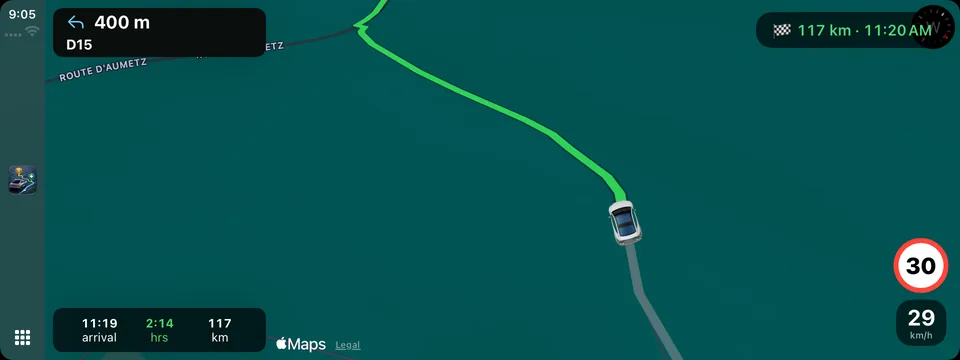
CarPlay
Add an errand from the car’s screen and the trip is rebuilt around it, with the detour, the opening verdict and the same guidance as on the phone.
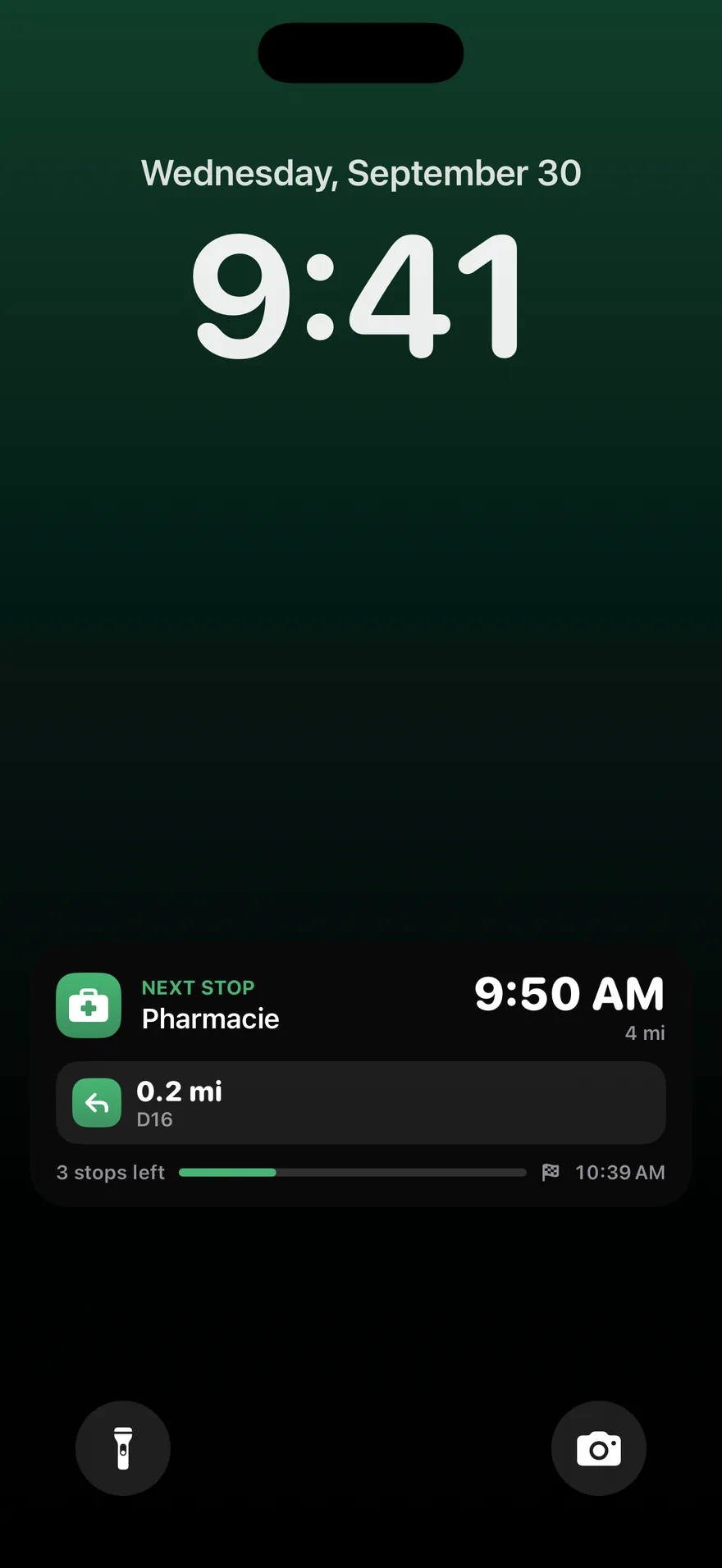
Lock Screen
A Live Activity keeps the next stop, the next turn and your progress in view — no unlocking.
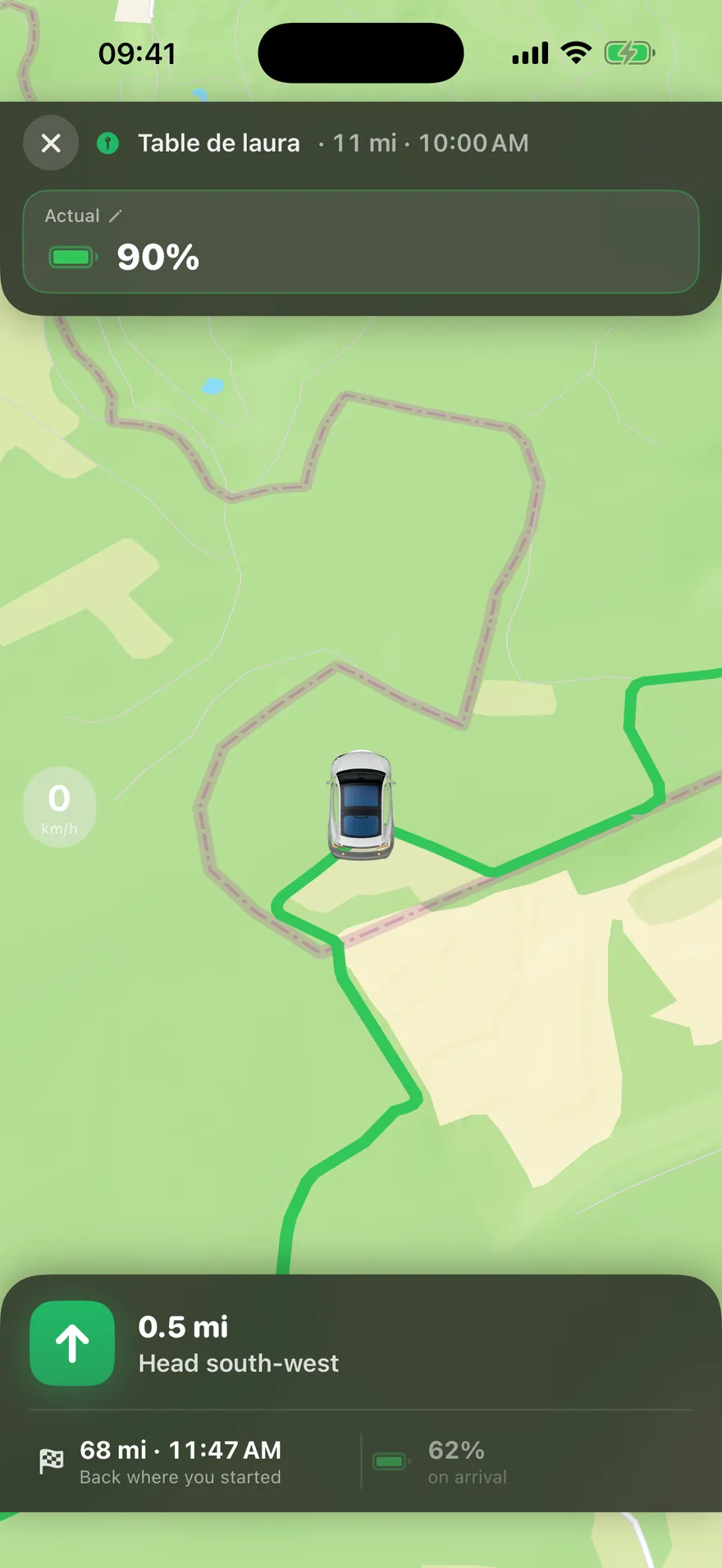
Turn by turn
Built-in guidance: distance to each maneuver, road names, the speed limit and spoken instructions.
Dynamic Island
The same Live Activity, one glance away at the top of the screen while you use other apps.
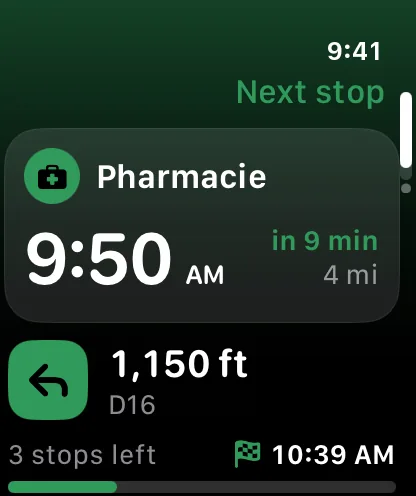
Apple Watch
The next stop, the next turn and the stops left, on your wrist.
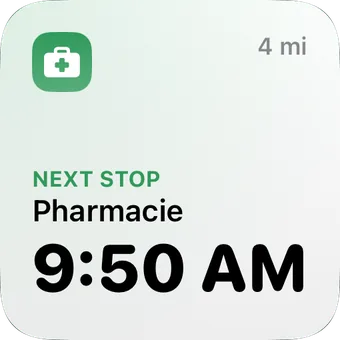
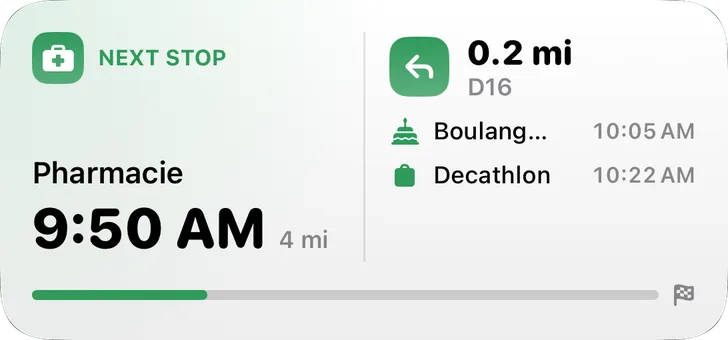
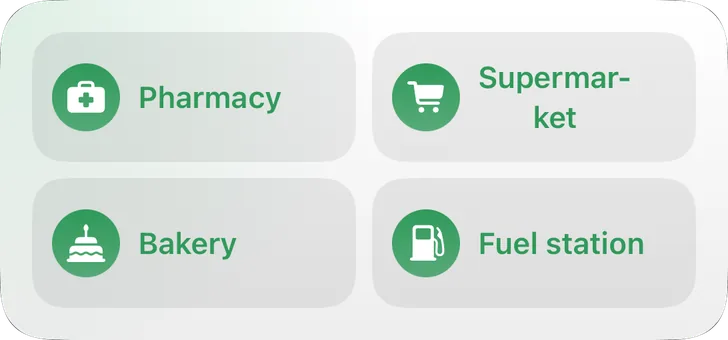
Home Screen widgets
Your trip at a glance in two sizes, plus one-tap buttons for four everyday errands: pharmacy, supermarket, bakery and fuel.
Siri and Shortcuts
Hands on the wheel? Just ask.
The whole app, one screen at a time.
From the first search to the last stop — swipe through the app, screen by screen.


Questions, answered.
Your next errand, already solved.
Set where you are going and what you need. Mini Detour finds the stops that fit — and tells you the truth about the ones it is not sure of.
Coming soon to the App StoreMini Detour